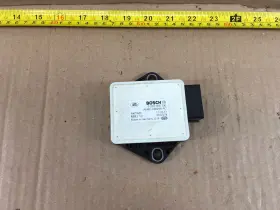
The Land Rover 1275100496 Yaw Rate Acceleration Sensor, part number ah42-14b296-ac, is a crucial component of the dynamic stability control system in certain Land Rover HSE models from 2010 to 2013. This sensor plays a significant role in ensuring the vehicle's stability and safety by monitoring the yaw rate, which is the rate of change of the vehicle's orientation around its vertical axis.
This high-precision sensor is designed and manufactured by Bosch, a leading automotive technology company known for its innovative solutions and top-tier quality. The sensor is compact in size, making it an ideal fit for modern vehicle applications, and is engineered to deliver accurate and reliable readings under various driving conditions.
The sensor utilizes a tri-axial accelerometer to measure the acceleration forces in all three axes (x, y, and z) of the vehicle. These measurements are then used to calculate the yaw rate, which is essential for the vehicle's stability control system to intervene when necessary, such as during sudden lane changes, hard braking, or other disruptive driving maneuvers.
The sensor housing is made from durable materials, ensuring it can withstand the harsh conditions encountered on and off the road. The sensor is designed to be easy to install, with clear mounting instructions provided in the packaging. Additionally, the sensor comes with a wiring harness to simplify the connection process to the vehicle's electrical system.
This Land Rover Yaw Rate Acceleration Sensor is a critical component for the proper functioning of the vehicle's dynamic stability control system. Replacing a faulty or worn-out sensor can help prevent potential accidents, improve overall vehicle performance, and enhance the driving experience. As with any automotive part, it is essential to ensure that the replacement sensor is of the highest quality and meets the exact specifications of your vehicle. The Land Rover 1275100496 ah42-14b296-ac Yaw Rate Acceleration Sensor from Bosch is an excellent choice for Land Rover HSE owners looking for a reliable and accurate replacement.
Buying a Land Rover 1275100496 (2010-2013 HSE) yaw rate acceleration sensor Ah42-14b296-ac involves considering both advantages and disadvantages.
Advantages of replacing the yaw rate acceleration sensor:1. Improved stability and safety: A faulty yaw rate acceleration sensor can affect the vehicle's stability control system and traction control system, leading to decreased handling performance and potential safety risks. Replacing the sensor ensures proper functioning of these systems.
2. Better driving experience: A well-functioning yaw rate acceleration sensor enhances the overall driving experience by providing accurate data to the vehicle's stability control system, resulting in smoother and more responsive handling.
3. Diagnostic capabilities: Replacing the yaw rate acceleration sensor can help identify and resolve other potential issues in the vehicle's electrical system, as a faulty sensor may cause diagnostic trouble codes that could indicate other problems.
Disadvantages of replacing the yaw rate acceleration sensor:1. Cost: The cost of replacing the yaw rate acceleration sensor can vary depending on labor costs, parts availability, and the specific vehicle model. It may be a significant investment for some Land Rover owners.
2. Time: Replacing the yaw rate acceleration sensor may require a visit to a professional mechanic or dealership, which can take several hours or even days, depending on the availability of parts and the workload of the service center.
3. Complexity: The yaw rate acceleration sensor is a component of the vehicle's complex stability control system. Replacing the sensor may involve diagnosing and addressing any related issues within the system, which could add to the overall time and cost of the repair.
In conclusion, replacing the yaw rate acceleration sensor (Ah42-14b296-ac) in a Land Rover 1275100496 (2010-2013 HSE) can provide several benefits, including improved stability, safety, and driving experience. However, it comes with potential drawbacks, such as significant cost, time investment, and potential complexity. Ultimately, the decision to replace the sensor should be based on the vehicle's specific condition, driving habits, and personal priorities. If the vehicle is experiencing stability or handling issues, or if the sensor is known to be faulty, replacing it may be a worthwhile investment. Otherwise, it may be advisable to wait until the sensor fails or until other more pressing vehicle issues arise.
Details:
Express shipping could be arranged, just let us know. Otherwise a $150 fee may apply.
specifications perfoelectric:
- for models: Hse, Range
- for years: 2010–2013
- brand: Land Rover
- mpn: 1275100496
- part type: Sensor
- country of origin: Germany
- performance part: Yes
general perfoelectric:
- category: Auto Parts > Electrical Components
seller perfoelectric:
- rating: 99.3%
- # reviews: 5159
- city: fords, new jersey
returns perfoelectric:
- paid by: seller
- policy: returns accepted
- time: 30 days
offer perfoelectric:
- options: ship-to-home
- sold #: 13
- prices: $20.14–$45.50
- item condition: Used
- started: january 25, 2026
- availability: in stock
- in stock #: 5
- best offers: true
shipping perfoelectric:
- class: standard, expedited, one-day
- transit: 4-8 days
- carrier: usps, fedex, ups
- type: calculated
- service: usps ground advantage, fedex 2day, ups next day air
payments perfoelectric:
- wallet: google-pay
- credit card: visa
- other
Also Viewed:
- RQT500130: CONTROL SUSPENSION MODULE, Land Rover
- YIB500090: PLAYER, Range Rover
- 85991-60070: SEAT BELT MODULE, Toyota
- 9098004110: CONDENSER RADIO, Toyota
- PRC7067: DIAGNOSTIC DISPLAY BOARD ECU, Land Rover
- GK529F836AB: PEDAL THROTTLE SENSOR, Land Rover
- HY3214F012BD: PRESSURE TIRE MONITOR MODULE, Land Rover
- DPLA19H440BB: KEYLESS ENTRY CONTROL MODULE, Land Rover
- J8A2-70718-FP: CONTROL MODULE, Land Rover
- DPLA18C858DC: DISPLAY, Land Rover
- JPLA-19H406-BJ: WINDSHIELD CAMERA MODULE, Land Rover